
THE PSYCHEDELIC PILGRIMAGE TO CALVARY
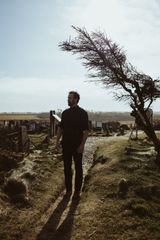
On revelation, refusal, and the difficulty of following Christ.
There were three Ayahuasca ceremonies in one year, and beneath everything they showed me there was a quiet and increasingly unwelcome suggestion that all of this was somehow going to lead back to Christianity.
I did not want it to.
I should say something about how little I knew when this began. I went in almost cold. I had done some yoga, a minimal amount of breathwork, and read a little Thich Nhat Hanh. That was about it. I had no understanding of Hindu scripture. I had never read the Upanishads or the Bhagavad Gita. I had essentially no exposure to Islam and had never opened the Quran. I did not have a comparative theology waiting in the background, ready to populate the experience.
The experiences came first.
The reading came later because I needed some way of understanding what had happened.
Ayahuasca opened an enormous territory. I encountered gods, animals, ancestors, intelligences, the dead, presences I had no name for. Sometimes I would come back from a ceremony, or wake from an extraordinary dream, and have to ask somebody what I had seen. Ganesh. Vishnu. Something from another tradition I knew almost nothing about. Later there was Lú and the older Irish world.
I am not saying that this proves those beings exist independently of consciousness. I am saying the imagery often preceded my conscious knowledge of the traditions through which I later tried to interpret it.
That distinction matters.
Eventually I began reading. The Upanishads. The Bhagavad Gita. The Tao Te Ching. The Bible. The Quran. Not systematically. I was trying to understand what kind of place I had found myself in.
The Tao Te Ching begins with perhaps the cleanest correction to mystical certainty ever written: “The Tao that can be told is not the eternal Tao.”
That sentence has stayed with me because psychedelic experience is particularly vulnerable to certainty. You encounter something with such force, such impossible coherence, that ordinary reality can appear impoverished beside it. The temptation is immediate. You want to say what it was. You want cosmology. You want hierarchy. You want to know which god, which dimension, which ancestral line, which frequency, which fucking portal you have just passed through.
The Tao says you don't know.
That has increasingly seemed to me the only intellectually respectable place to begin.
During my first Ayahuasca ceremony I went, experientially at least, beyond the cosmos. At a threshold that felt more substantial than the room in which my body was lying, I encountered a figure who appeared as Jordan Peterson, dressed in purple robes. He greeted me by name. “Welcome, Niall. We have been waiting for you.”
I am careful now about what sort of claim I make from an experience like that. I don't know where I went. I don't know what Peterson represented, whether anything independent of me was present, or whether the entire encounter emerged from regions of my own psyche I ordinarily cannot reach.
What I know is that where I stood felt more real than here.
And strangely, I wasn't particularly interested in staying.
I wanted to know about my life.
I was besieged by questions. Why all the suffering? Why had I caused so much of it myself? Why had my parents had to watch their second son die through anorexia, seemingly turning his own will against his body until the body could no longer survive it? Why had I caused such pain to Marina? The following morning came the grief of separation from my children and the knowledge that some of what I suffered had not merely happened to me. I had participated in its creation.
That mattered because if this other place was somehow more real, I wanted to know why I had to come back here.
I was given an answer.
It was not sufficient.
I will leave that for another time.
What remained was the question itself. Why incarnation? Why this astonishingly convincing arrangement of flesh and weather and sex and grief and children and appetite and cruelty and tenderness? We talk casually about what happens after death as though we have understood what is happening before it. I don't think we have the faintest comprehension of being here.
Life does not strike me as an examination we are supposed to solve. It feels closer to a wildly participatory story. Suffering is built into it. So is beauty. So is our extraordinary capacity to damage one another. We are not spectators. We alter the story simply by entering the room.
Somewhere in those early ceremonies I also had the peculiar conviction that Christ was rising again through the culture. Not Christ as institutional possession, nor necessarily the Christianity I had inherited, but the pattern, the message, the consciousness of Christ moving through plants and people and now encountering technology.
Two thousand years ago the message moved through a handful of people, then intermittently through mystics such as Hildegard, Eckhart, Julian of Norwich, John of the Cross and countless unnamed others. Now a single voice can cross the planet before breakfast.
I don't know what to make of that intuition.
I do know that between my first ceremonies in 2022 and now, Christianity has become considerably easier to speak about in the cultural spaces I inhabit. There was a period when almost any spiritual vocabulary was acceptable except the Christian one. Buddhism was fine. Shamanism was fine. Psychedelics, non-duality, manifestation, tantra, astrology, breathwork, all perfectly discussable. Mention Christ and suddenly everyone became nervous about doctrine.
That seems to be changing.
Whether that has anything whatsoever to do with what I experienced is another question.
My own return was more intimate than cultural. It became ancestral.
During a San Pedro ceremony on a soft summer afternoon I caught my reflection in a window and saw, quite plainly, an Englishman.
Not an archetype. Not a spirit guide.
An Englishman.
It startled me.
Maxwell. Parkinson. North of England, south of Scotland. The Irish ancestry is there too, Lawless and Finnegan further into the maternal line, but suddenly another inheritance was looking straight back at me. I began to understand that whatever spiritual work I thought I was doing could not consist entirely of travelling elsewhere. There was history in my own face.
Christianity was part of that history. It had shaped the people who shaped the people who eventually made me. It had produced beauty, metaphysics, cathedrals, contemplation and extraordinary human beings. It had also become entangled with empire, punishment, domination, sexual shame, sectarianism and violence.
Walking towards Christ therefore could not mean pretending Christianity had been innocent.
Nor could rejecting Christianity make me innocent of it.
I had to go through the gate.
Later I took up a drum and followed a guided shamanic journey to find a spirit animal. I descended through root and rock and eventually emerged into a clearing corresponding closely to a sacred place in Wicklow I knew in waking life. Animals appeared. Raven. Deer. A white stag among the trees. Mouse. Hedgehog. The wild gathering around me.
Then came an unexpected pang of guilt. I felt disloyal.
I turned.
Christ was standing there.
I asked him whether what I was doing was okay. His response was calm.
“Anyway to victory.”
I understood it at the time as permission. Christ was not threatened by the animals, the underworld, the older gods, the plants, or my wandering through traditions that Christianity had historically regarded with deep suspicion. I did not have to manufacture a power animal. Christ had already become the figure orienting the journey.
But even that is too clean when I tell it now.
Because being shown Christ is not the same thing as following him.
Last year, during an Acacia ceremony, I was offered what felt like an opportunity to do precisely that. Christ was some distance ahead of me, moving towards light, and I understood that I could follow.
I faltered.
I wanted confirmation.
From the shaman, perhaps. From a friend. From someone outside the experience who could assure me that this was safe, legitimate, allowed.
Christ was there and I did not trust him.
That may be more important than all the visions.
Because I recognise it perfectly well in waking life.
I can speak about Christ more easily than I can follow him. I can contemplate loving my enemy while remaining extremely capable of contempt. I can understand “turn the other cheek” and still feel the old readiness to draw the sword. I am capable of being harsh and cutting. If anything, increased consciousness can simply make the blade more precise.
That is not transformation.
It may only be improved weaponry.
And here the Christian teaching becomes much more difficult than the agreeable version in which being Christian means becoming nicer. Christ's instructions are not particularly nice. Love your enemies. Bless those who curse you. Forgive again and again. Remove the obstruction from your own eye before becoming preoccupied with somebody else's. Lose your life in order to find it. Take up your cross.
These are violent instructions if taken seriously, because something in us does not survive them intact.
Even “I did not come to bring peace, but a sword” requires care. It would be very convenient for me to take that sentence as divine authorisation for my own capacity to sever, confront and condemn. I don't think I get away with that.
The sword Christ speaks of cuts through loyalties and attachments. It divides. Truth does sometimes require separation. There are things that should be refused, relationships that should end, lies that should be named, rotten structures that should be cut away.
But the sword has to pass through me too.
Especially through me.
Perhaps that is part of my task. Not to become harmless, and certainly not to become agreeable, but to learn how to wield discernment without hatred. To cut what is rotten without needing to despise it. To know when force is required and when force is simply woundedness enjoying the dignity of a principle. To become capable of saying no without secretly requiring the other person to suffer for having made the no necessary.
I am nowhere near mastering that.
Which is why Calvary has become stranger to me rather than more comprehensible.
In one psychedelic experience I did not see a man hanging on the cross.
I became him.
Again, I don't know what ontological claim to make from that. I am not claiming that I became Christ. I am saying that the distinction between observing the image and inhabiting it disappeared. The crucifixion was no longer a theological proposition taking place safely two thousand years ago. For whatever duration the experience lasted, it became an event in consciousness.
That altered my understanding of the Christian message.
I had previously heard “love your enemy” primarily as a moral instruction. Something good people ought to attempt. Increasingly I wonder whether Christ was describing something closer to the architecture of reality itself.
Hatred binds. Resentment binds. The refusal to forgive binds. The sword used wrongly binds the wielder to whatever he is trying to destroy.
Perhaps love of the enemy is not ethical decoration added to Christianity once the metaphysics have been established. Perhaps it is metaphysics. Perhaps Christ is describing how to move through this strange participatory reality without becoming permanently entangled in everything that wounds us.
I don't know.
And I have become suspicious of the part of me that desperately wants to know.
Ayahuasca gave me experiences of staggering depth. Some were beautiful. Some were terrifying. Some remain completely beyond my ability to interpret. I still love the visceral quality of it, the sense of being taken down beneath personality into tissue and bone marrow, into something ancient enough that language begins to look ridiculous.
But I no longer think intensity proves ultimacy.
A psychedelic experience can feel more real than ordinary life and still leave you completely incapable of loving the person who irritates you the following afternoon.
Christ keeps bringing me back to that humiliation. Not to whether I have understood consciousness, but whether I can participate in it differently. Whether I can forgive. Whether I can tell the truth without using truth as a weapon. Whether I can wield the sword without hatred. Whether I can recognise what is rotten in another person without feeding the same rot in myself. Whether, when Christ is some distance ahead of me and the light is behind him, I can follow without turning around to ask somebody else if it's okay.
I don't yet know why this life should contain so much suffering, why some of it arrives without invitation and why so much more passes through our own hands on its way to somebody else. I don't know why consciousness appears to be here at all, or what this astonishing story is asking of us.
I know only that when I was offered the chance to follow him, I hesitated.
And that I am still hesitating.